The Art of Rehabilitation: From Practice to Mastery
How do you help someone develop professional judgment when the most valuable lessons come from experience?
That question inspired this gamified eLearning experience designed to help physiotherapy assistants strengthen their client analysis and exercise prescription skills.
Instead of presenting information upfront, I placed learners directly into realistic client scenarios where they must analyze information, make decisions, and learn from feedback. As their abilities develop, the challenges become increasingly complex, encouraging deeper reasoning and greater independence.
Developed through Marie-Jo Leroux's Effective Gamification Framework, this project combines performance-based instructional design, authentic challenges, and motivational mechanics to transform learning into a journey from practice to mastery.
Audience: Physiotherapy Assistants
Project Type: Gamified, scenario-based eLearning
Responsibilities: Instructional Design, Game and Scenario Design, eLearning Development, Visual Design, Programming, and Prototyping
Tools Used: Articulate Storyline 360, ChatGPT, Microsoft Copilot, Magnific AI
Methodologies: Action Mapping, Performance-Based Instructional Design, Effective Gamification Framework
Knowledge alone doesn't create professional judgment.
Physiotherapy assistants need more than an understanding of anatomy, biomechanics, and exercise science. They must interpret physiotherapy notes, communicate with clients, recognize movement limitations, and make appropriate exercise-related decisions within the physiotherapist's treatment plan.
These skills develop through experience, but traditional mentorship and job shadowing cannot guarantee exposure to a wide variety of client situations.
Some learners encounter complex conditions early in their careers. Others may have limited opportunities to practice certain decisions.
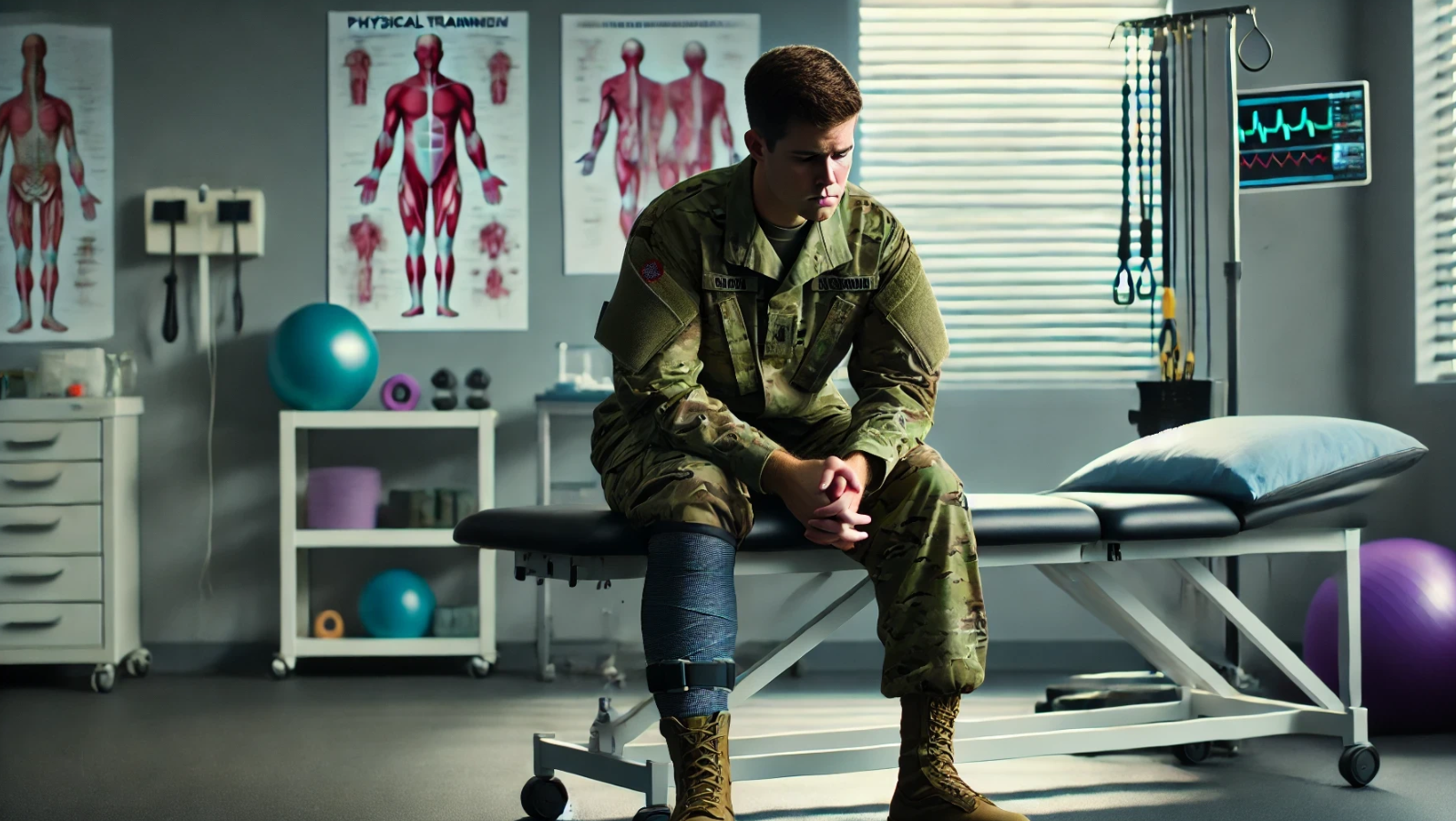
The challenge was to create a consistent, safe environment where learners could repeatedly practice essential job behaviors, encounter diverse client situations, and learn from their mistakes.
The Problem
Learn by doing, not by watching.
I designed an interactive rehabilitation environment where learners work with unique clients across four clinics, making the same types of decisions they would encounter in professional practice.
Each scenario follows two phases:
Phase 1 — Client Analysis
Learners interpret physiotherapy notes, identify priorities, ask relevant questions, and assess movement limitations.
Phase 2 — Exercise Prescription
Using their findings, learners identify relevant body regions, select appropriate exercises, and determine suitable exercise intensity.
Instead of receiving extensive instruction beforehand, learners develop their understanding through a repeating cycle:
Challenge → Decision → Feedback → Reflection → New Challenge
The experience was designed around three principles:
The Solution
Designed to Last: Authentic decision-making challenges and repeated practice support the development of skills that can transfer beyond the learning environment.

Designed to Inspire: Immersive environments, distinctive clients, meaningful choices, and progressive challenges encourage learners to remain engaged and take ownership of their development.

Designed to Change: Realistic scenarios and contextual feedback encourage learners to move beyond memorizing exercises toward more thoughtful, client-centred decisions.

The experience complements rather than replaces supervised clinical training.

Start with performance, not content.
My initial instinct, given my background in physical education and fitness, was to focus on anatomy, biomechanics, and exercise science.
However, knowing these subjects does not automatically translate into effective decisions with clients.
I needed to identify what successful practitioners actually do, then design opportunities to practice those behaviors.
My process followed four stages:
Action Mapping: Identify the behaviors required for successful performance.
Final Challenge: Design an authentic assessment of those behaviors.
Macrostructure and Motivational Design: Build a progressive learning journey that supports practice and engagement.
Interactive Prototyping and Development: Test the mechanics, refine the experience, and bring the design to life.
My Process
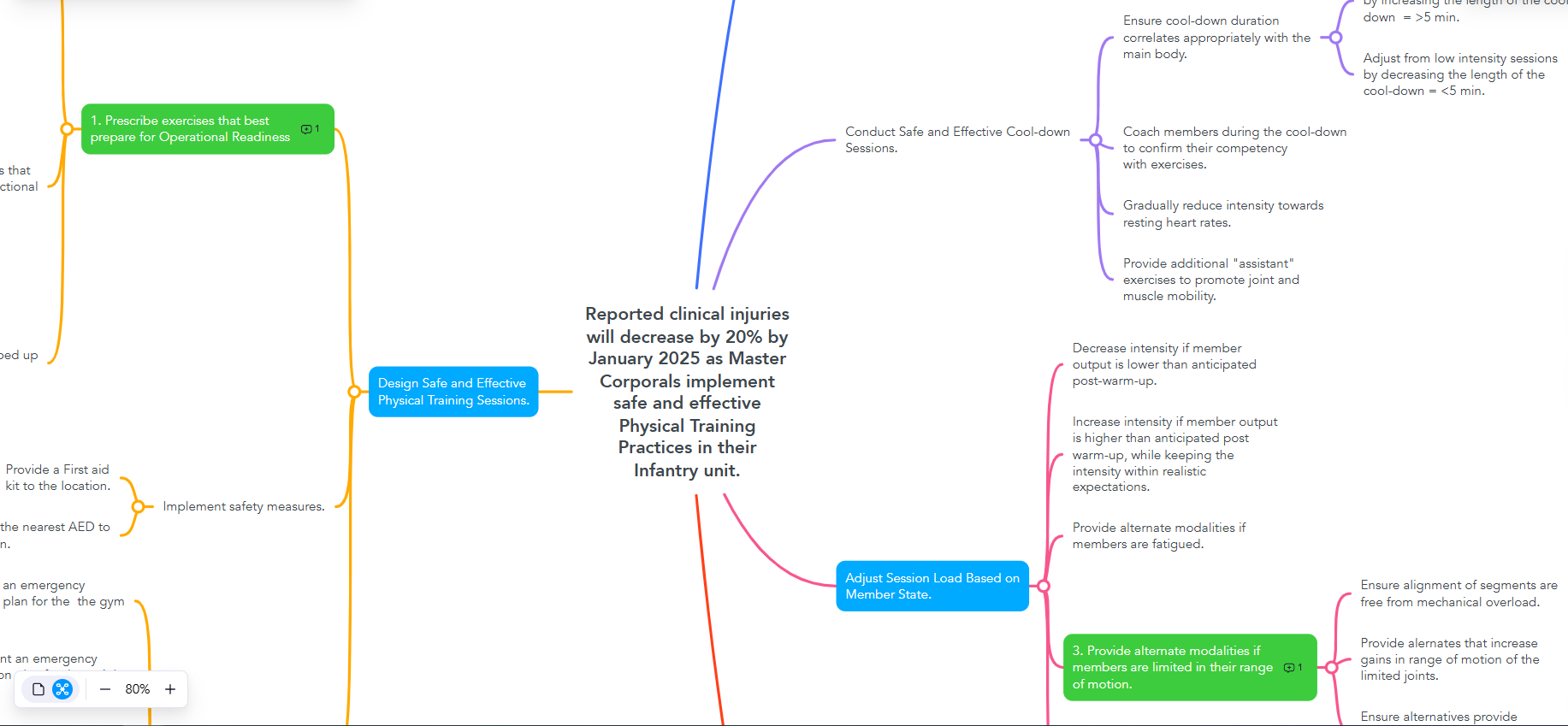
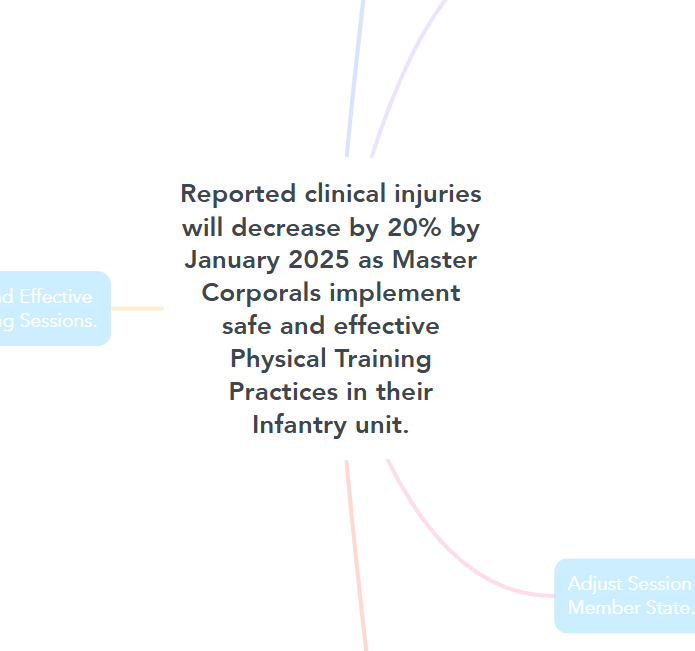
Action Map
What do learners need to do differently?
Action Mapping, developed by Cathy Moore, begins with a measurable performance goal and identifies the actions required to achieve it.
For this proof of concept, I established a hypothetical objective: contribute to a 20% improvement in patient satisfaction within six months through better client interactions and exercise-related decisions.
From there, I identified two essential performance areas.
1. Client Analysis
Interpret notes, identify priorities, ask relevant questions, select appropriate assessments, and use the findings to understand the client's needs.
2. Exercise Prescription
Identify relevant body regions, distinguish between effective and ineffective interventions, select appropriate exercises, and determine suitable intensity.
These behaviors became the foundation of every challenge.
The Action Map also helped me evaluate design decisions. If an activity did not contribute to the desired performance, it did not belong in the experience.
Interactive Prototype
Practice authentic decisions, not information recall.
During the Effective Gamification Framework, I explored Cognitive Mechanics, which focus on the mental actions learners perform when solving authentic problems.
For example, a traditional activity might ask learners to identify muscles involved in shoulder movement.
A cognitive challenge presents a client struggling with overhead movement and asks the learner to determine what information matters, what should be assessed, and which exercises are appropriate.
The difference is significant: one tests knowledge, while the other requires learners to apply it.
Before investing in elaborate visuals and programming, I created an interactive prototype to establish whether these decision-making mechanics could form the foundation of an engaging learning experience.
I began with the most demanding activity: the Final Challenge.
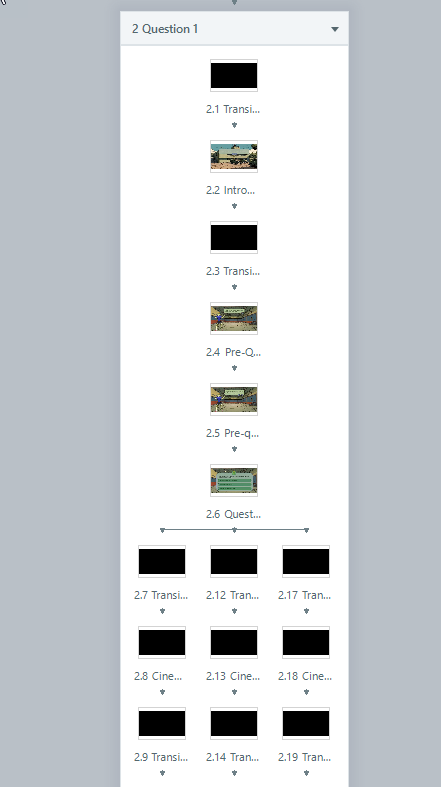
Final Challenge
Design the destination before building the journey.
Although learners encounter the Final Challenge last, it was the first challenge I designed.
Its purpose was to combine every critical behavior from the Action Map into one comprehensive client scenario.
Learners must review physiotherapy notes, identify relevant information, ask questions, interpret movement assessments, select exercises, and determine appropriate intensity.
The challenge includes effective, partially appropriate, and ineffective choices.
This was intentional. In professional practice, the difficulty often lies in distinguishing between several plausible alternatives rather than identifying an obviously incorrect answer.
I also wanted the challenge to be genuinely difficult for inexperienced learners.
By defining what mastery should look like first, I could work backward and design practice activities that gradually prepared learners for that level of performance.
From simple decisions to complex reasoning.
With the Final Challenge established, I designed an introductory level followed by four sections containing three client challenges each.
The resulting experience offers 1 introductory and 12 practice levels, followed by the Final Challenge.
Every level follows the same underlying decision-making process, but the complexity increases as learners progress.
Stage
Challenge progression
Introduction
Simple decisions, one assessment area, one exercise
Section 1 — Levels 1–3
Foundational analysis, three broad assessment areas, two exercises
Section 2 — Levels 4–6
More competing information, two body regions, three exercises
Section 3 — Levels 7–9
More complex limitations, multiple assessment areas, four exercises
Section 4 — Levels 10–12
Detailed assessments, additional distractors, three body regions, five exercises
Final Challenge
Comprehensive application of the complete decision-making process
Exercise intensity also becomes more complex, progressing from limited choices to multiple options, including perceived exertion.
For example, an early shoulder scenario might present a relatively obvious limitation. Later, learners may need to consider how thoracic spine mobility and scapular mechanics contribute to an overhead movement problem.
The objective is to progressively develop more sophisticated reasoning without overwhelming learners at the beginning.
Macrostructure
Motivational Mechanics
Motivation through mastery, autonomy, and meaningful progression.
Effective gamification involves more than awarding points or badges.
I wanted the challenges themselves to be engaging, with enough difficulty to encourage growth without creating unnecessary frustration.
To support this balance, I developed several interconnected motivational mechanics.
Stars and progression gates
Learners earn stars based on their performance:
1 star: Complete the challenge
2 stars: Achieve at least 60%
3 stars: Achieve at least 80%
Accumulating stars unlocks new sections.
Rather than forcing everyone through every scenario, this system rewards demonstrated competence while preserving opportunities for additional practice.
Highly skilled learners can progress sooner, potentially completing as few as five of the thirteen introductory and practice levels before the Final Challenge.
Others can complete every scenario to gain more experience and feedback.
Learner autonomy
Within each clinic, learners choose which client to serve first. They also decide whether to continue practicing or advance once they have earned sufficient stars.
Optional power-ups provide additional assistance, giving learners control over when to seek support.
These choices make progression feel earned rather than prescribed.
Meaningful feedback
Client analysis and exercise prescription are evaluated separately.
This distinction allows feedback to address specific weaknesses. A learner might gather excellent information but select less appropriate exercises, or make reasonable exercise choices despite overlooking important client details.
Rather than simply identifying correct and incorrect answers, feedback explains the reasoning behind decisions and helps learners improve.
Every visual serves a purpose.
Visual design was essential to making the experience believable, engaging, and easy to navigate.
I focused on three elements: the environments, the clients, and the exercise prescription interface.
Visual Design and Immersion
Environments that communicate progression
The experience begins with an isometric city map connecting four rehabilitation clinics.
Each clinic has a unique waiting room and exercise environment, becoming progressively more sophisticated as learners advance.
This makes progression visible rather than relying exclusively on scores or rewards.
Within each clinic, learners select which client to serve, reinforcing autonomy while maintaining a consistent learning structure.
Clients with distinct identities
Every client presents unique circumstances, movement limitations, and visual characteristics.
Using Microsoft Copilot, I developed individual characters with seven different poses to support their interactions throughout each scenario.
This variety helps prevent the repeated decision-making structure from becoming monotonous.
It also reflects an important aspect of real practice: even when clients present similar problems, their needs and interactions are never identical.
Exercise illustrations guided by expertise
One of the greatest visual challenges was accurately representing exercises.
The initial prototype used exercise names alone. While functional, this lacked the clarity and immersion I wanted.
Generating accurate anatomical positions through text prompts proved unreliable.
My solution was to photograph myself performing the exercises and use those photographs as AI references.
This produced more reliable illustrations and allowed me to combine my exercise science background with AI-assisted visual development.
The process reinforced an important lesson: AI can accelerate production, but subject matter expertise remains essential for evaluating its output.
The virtual exercise tablet
Instead of presenting exercises as conventional multiple-choice questions, I created a virtual electronic tablet.
Learners use it to navigate exercise categories, review collected client notes, select exercises, and access available power-ups.
The interface reflects the digital tools used in professional settings and keeps learners immersed in their role rather than pulling them out of the scenario to complete a quiz.
Making a complex learning system work.
Developing the experience in Articulate Storyline 360 required coordinating variables, conditional triggers, object states, layers, and navigation across multiple client scenarios.
The challenge was not simply creating individual interactions. It was ensuring that every system worked together as learners made different decisions and followed different paths.
Interactive Development and Programming
Scoring and progression
I developed separate scoring systems for client analysis and exercise prescription.
Each level calculates performance against its available points, determines the appropriate feedback, and awards stars.
Cumulative results control section progression, allowing learners to advance based on demonstrated performance.
Randomized choices and conditional interactions
To discourage memorizing answer positions, I used Storyline's freeform functionality to randomize relevant choices.
Some activities also require multiple selections, with feedback provided between decisions.
These interactions required careful management of variables and slide revisiting behavior to preserve learner progress and prevent scoring or navigation errors.
Power-ups and contextual assistance
I programmed a power-up system that provides optional visual assistance during certain decisions.
Its functionality depends on multiple conditions, including availability, activation, and the learner's current interaction.
Developing it required troubleshooting object states, layers, and trigger timing.
One particularly challenging issue involved exercise information overlays that appeared correctly once but failed to reappear. I resolved it by changing when the reveal triggers executed, ensuring the information displayed whenever the relevant layer opened under the appropriate conditions.
Flexible client selection
Learners can complete clients in different orders, meaning the waiting room must reflect which clients remain available.
Rather than producing separate animations for every possible combination, I used layered character assets and selective animations.
This preserved learner autonomy while keeping production manageable.
These technical decisions illustrate an important aspect of the project: the programming was not separate from instructional design. It was what made the intended learning experience possible.
Results and Takeaways
A proof of concept for performance-focused gamification.
The Art of Rehabilitation: From Practice to Mastery was developed as a portfolio proof of concept rather than an implemented organizational training program.
Therefore, improvements in patient satisfaction, workplace performance, and other organizational outcomes have not been measured.
However, the experience demonstrates how authentic challenges, progressive difficulty, feedback, and motivational mechanics can be combined into a cohesive learning system.
Financial Value: The experience offers a scalable approach to providing consistent practice opportunities. In an organizational setting, it could supplement mentorship, reduce reliance on repeated instructor-led explanations, and help learners prepare for supervised client interactions more efficiently.

Strategic Value: By focusing on observable job behaviors rather than content completion, the experience connects learning activities to professional performance. Its structure could support more consistent decision-making and provide a foundation for evaluating skill development across learners.

Personal Value: Learners can build confidence through repeated practice, meaningful feedback, and visible progression. The ability to make mistakes safely, revisit challenges, and advance through demonstrated competence supports a greater sense of autonomy and professional growth.

Key takeaways
This project reinforced several principles that continue to shape my approach to instructional design.
Performance comes first. Action Mapping and designing the Final Challenge early helped ensure every activity supported meaningful job behaviors.
The challenge is the most important game mechanic. Stars, progression, and power-ups support engagement, but authentic decisions and useful feedback are what give the experience its learning value.
Autonomy requires intentional design. Flexible progression and client selection create meaningful choices, but require careful instructional planning and technical development.
Visuals should communicate, not decorate. The environments, characters, illustrations, and tablet interface were designed to support immersion, comprehension, and progression.
Technology should serve the learning strategy. AI-assisted visuals and advanced Storyline programming expanded what I could build, but their value came from supporting the intended learner experience.
Final Reflection
This project represents the intersection of my background in exercise science, instructional design, visual development, and programming.
My goal was to create something more meaningful than a course that presents information and checks understanding.
I wanted learners to experience the satisfaction of developing a skill: facing a challenge, making decisions, learning from mistakes, and gradually becoming more capable.
For me, that is the greatest opportunity gamification offers workplace learning.
Not making learning look like a game, but using the principles of good game design to make meaningful practice more engaging, motivating, and effective.